

The Power of Images in Marketing
When Visual Becomes Strategy
Images have an unfair advantage. They don’t wait to be interpreted. They arrive, and that’s enough.
Not magic. Instinct. Speed.
It’s the reason why, in marketing, impact is almost always visual before it’s rational. Perception comes first. Meaning follows.
The campaigns that truly resonate all share this dynamic. The story is already embedded in the image. Words step in later, not to explain, but to steer.
In Marketing, the Eye Decides Before the Mind Does
You don’t need more images. You need one that holds.
There’s still a tendency to equate effectiveness with volume: more shoots, more content, more variations. But presence doesn’t come from repetition.
The most compelling campaigns tend to orbit around a single, dominant visual. One that creates tension instantly. One that suggests more than it shows.
When something lands, it’s because it’s precise. The subjects aren’t decorative. They’re intentional. Aligned with the brand, anchored in a clear idea.
At that point, the image stops being an asset. It becomes a shortcut to meaning.
Visual Storytelling: When an Image Opens a Narrative
Some images have the ability to trigger an immediate narrative.
At Atravisio, this is exactly where we focus: developing visual systems that can tell a story in just a few seconds, through associations that stand out and generate an instant response.
One example is the #exist campaign, created to highlight the gap between the realities experienced by children born on the same planet, yet in profoundly different contexts: on one side, a dimension where there is freedom to imagine; on the other, a condition defined by pure survival.
The contrast takes shape through two figures placed side by side, separated by a glitch — a visual device that makes the fracture between these worlds immediately visible. On one side, a superhero, a universal symbol of strength and invincibility; on the other, a child in a war zone.
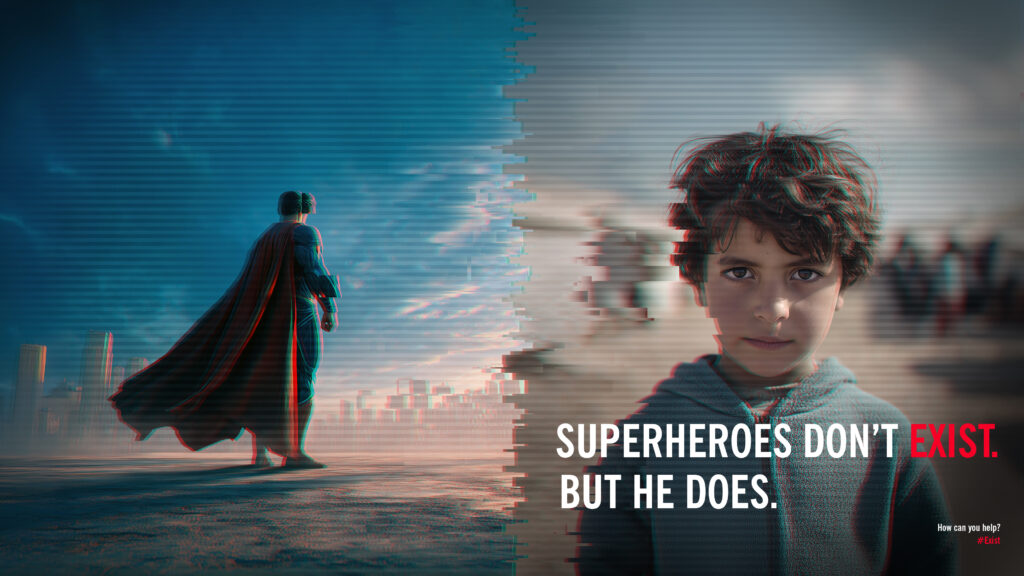
A single line accompanied the image:
SUPERHEROES DON’T EXIST. BUT HE DOES.
Short and direct, designed to create immediate impact.
Unlike many campaigns that address themes such as denied rights or war scenarios through explicit visual language, here the narrative emerges from the juxtaposition of two seemingly distant images. The war itself is not shown — what is communicated is the emotional distance between two worlds.
The contrast between imagination and reality becomes clear in just a few seconds, triggering a more subtle reflection on the gap between what we imagine and what actually happens.
It is precisely this kind of narrative tension immediate and memorable, that allows an image to become a clear, powerful message designed to last.
In an Endless Feed, Only What Holds You Matters
Images today are constant. Consumed, dismissed, replaced. All within seconds.
So the question isn’t how much you produce. It’s whether anything makes someone pause.
When it does, the shift is subtle but decisive. The image stops behaving like advertising. It becomes something else.
A fragment of narrative. Something that lingers, even briefly.
Creating Images That Work
When an image works, it’s never accidental. There’s always intent behind it. Structure. Direction. The ability to distill an idea into something immediate.
Visual communication doesn’t start with aesthetics. It starts with clarity. What are you saying, to whom, and why does it matter.
From there, everything is reduction. Stripping complexity down to something essential, but never simplistic.
That’s where the image exists. At the intersection of strategy and perception. Where an idea takes form, quickly, but not casually. At Atravisio, communication is an act of precision.
A process of subtraction, until what remains is strong enough to be seen, and remembered.


